


Sounds and Notes: How Music Is Made
Music is made up of several key elements that work together to create the sounds we love. Whether you're 8 or 80, understanding these building blocks will help you appreciate and create music more confidently. Let’s begin by exploring the foundation of all music: sound.
Sound is created when something vibrates, sending waves through the air that our ears perceive as music or noise. In music, sound has three key qualities:

🎵 Pitch (High & Low Notes)
Pitch determines how high or low a sound is. In music, pitches are organised into scales, forming the basis of melodies and harmonies.
Notes are named using either the letter system (C, D, E, F, G, A, B) or the solfège system (do, re, mi, fa, so, la, ti/si, do). While naming conventions vary, the core principles remain the same.

⏳ Duration (Long & Short Notes)
Duration refers to how long or short a sound lasts - a ringing bell lasts longer than a quick hand clap.
In written music, duration is shown by the shape and fill of a note. A whole note/semibreve (𝅝) lasts longer than a quarter note/quaver (𝅘𝅥𝅮), and notes with stems and flags are usually shorter than notes without.

🔊 Dynamics (Loud & Soft Sounds)
Dynamics indicate how loud or soft a sound is. Whispering is soft (piano, "p"), while shouting is loud (forte, "f"). However, loudness is relative - different instruments have varying volume ranges, and perception of sound levels can change based on context.
Example: A lullaby is typically played softly, while a march is performed with greater volume.
Symbols & Notation ✍ (How We Write Music)
Musical notation is the system we use to visually represent music. At its heart are notes - symbols that show both the pitch (how high or low a sound is) and the duration (how long it lasts). Each note stands for a specific sound that can be recognised, measured, and written down, forming the foundation of most musical pieces.
These notes are placed on a musical staff (plural "staves") - a set of five horizontal lines that helps us organise pitches and read music accurately.


But notes are just the beginning! A musical score includes many other symbols and markings that help convey a composer’s full intention. Here are a few examples:

Rests
Rests work like note symbols, but instead of representing sound, they show silence. Each rest has a specific duration, letting musicians know when not to play and for how long.

Clefs
A clef sets the pitch range for the notes on the staff, helping musicians read music more easily. Different clefs are used for different instruments, depending on whether they play high or low notes.

Time Signatures
Time signatures tell us how music is counted and grouped. The top number shows how many beats are in each bar, and the bottom number tells us which note value equals one beat (for example, "4" means a crotchet or quarter note).

Other
Music notation also includes symbols for tempo, articulation, and expression. In contemporary music, composers sometimes even create new symbols to suit their unique style or ideas.
Elements of Music
Melody
Melody is the main tune you sing along to - it's made of musical notes that vary in pitch and duration, creating a musical "story" or journey.

↗️ Going Up
Pitches get higher
↘️ Going Down
Pitches get lower
Staying The Same
Pitches repeat
The Musical Alphabet:

Famous Melodies:
-
"Twinkle, Twinkle, Little Star" - mostly repeating notes, then going up and down
-
"Happy Birthday" - starts low, jumps up high, then comes back down
-
"Mary Had a Little Lamb" - simple up and down pattern
💡 Try This: Hum your favorite song and draw the melody with your finger in the air - up when the notes go higher, down when they go lower!
Harmony
Harmony is when different notes play together at the same time. It's like having musical friends that support and enhance the main melody!

🎵 Melody (Main Tune)
The musical lines you sing along to
----------

🎼 Harmony (Supporting Notes)
Extra notes that make it sound fuller
----------
----------
----------
Types of Harmony:
😊 Consonant (Pleasant)
Notes that sound peaceful and stable together
😤Dissonant (Tense)
Notes that create tension and feel uncomfortable
Types of Chords:
😄Major Chords
Sounds happy and bright
😢Minor Chords
Sounds sad or mysterious
😈Diminished and Augemented Chords
Sounds spooky or tense
🎪 Hear It Everywhere:
-
Choirs: Multiple voices singing different notes together
-
Guitar strumming: Playing several strings at once to creat chords
-
Piano playing: Both hands working together to create melody and harmony
-
Orchestra: Different instruments alternating between playing the melody and playing a supporting part
Rhythm and Pulse/Beat
Rhythm is the pattern of sounds and silences in music, while pulse is the steady beat that keeps everything together - like music's heartbeat!

👏 Clap
Strong beat
✋Pat
Weak beat
🤫 Rest
Silent beat
⚡Quick
Fast beats
🫀 Understanding Pulse:
-
The pulse or beat is like music's heartbeat - a steady, regular beat you can feel throughout a musical work.
💓💓💓💓
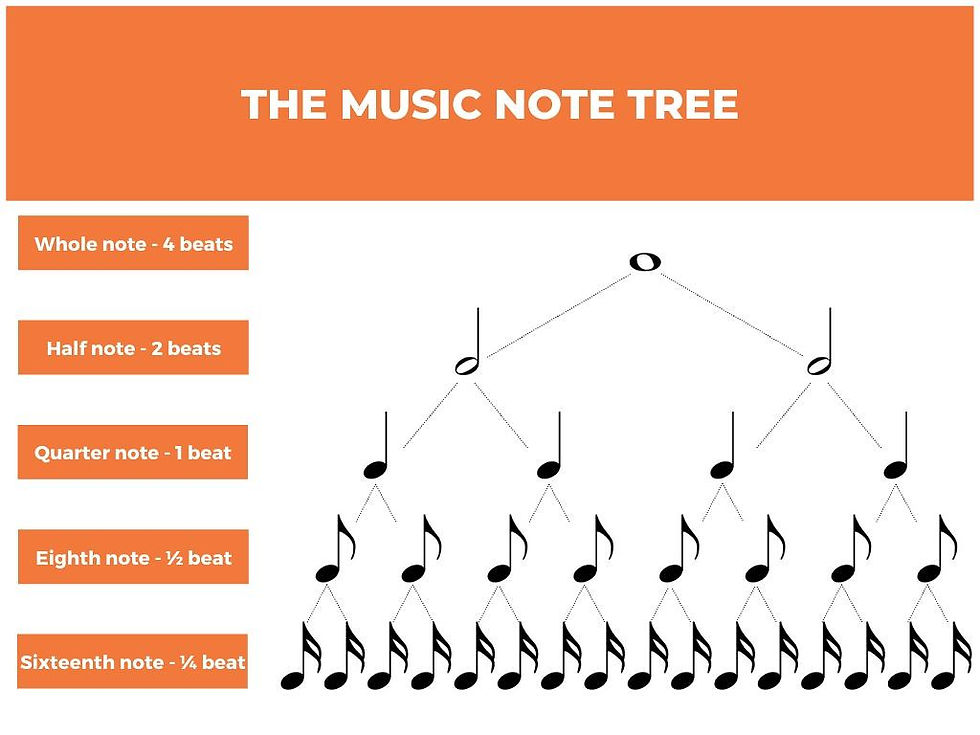
⏰ Note Duration:
• Whole note/semibreve: Very long (4 beats) 🎵━━━━
• Half note/minim: Medium long (2 beats) 🎵━━
• Quarter note/crotchet: One beat 🎵━
• Eighth note/quaver: Half a beat 🎵
Chart below by hellomusictheory.com.
Metre (Time Signature)
Metre is how we group beats together into regular patterns. It's like organising music into packages that repeat over and over! Here are some common time signatures:

👏 4/4 Time
Four beats per measure - most common!
Examples: Most pop songs, "Twinkle Twinkle"
💃3/4 Time
Three beats per measure
Examples: Waltzes, "Happy Birthday"
🚶2/4 Time
Two beats per measure
Examples: Marches, polkas
To Read Time Signatures:
-
The top number: Indicates the number of beats per measure
-
The bottom number: Indicates what types of beats we are counting (halves/minims? quarters/crotchets? eighths/quavers?)
🌟 Why Metre Matters:
-
Dancing: Helps you know when to step!
-
Singing or making music together: Keeps everyone in time
-
Emotional feel: 3/4 feels like floating, 4/4 feels steady
-
Music structure: Creates predictable patterns our brains love
Tempo
Tempo is how fast or slow music goes. We count the pulse/beat in BPM - beats per minute. Musicians can use a metronome to check or set the tempo they want, which is usually indicated either with a word (often in Italian) associated with a particular speed, or with a specific number/range.

🐌 Largo
Slow (47–60 BPM)
Like a funeral march
🚶Andante
Walking pace (76–97 BPM)
Like a comfortable walk
🚶♀️Moderato
Moderate (98–112 BPM)
Not too fast, not too slow
🏃 Allegro
Fast (115–143 BPM)
Like a happy jog
💨Presto
Very fast (162–200 BPM)
Like running to catch a bus!
How Tempo Affects Mood:
Slow
-
Feels calm and peaceful
-
Good for sad or romantic music
-
Helps with relaxation
-
Example: Lullabies
Fast
-
Feels exciting and energetic
-
Good for dance music
-
Makes you want to move
-
Example:
🎯 Tempo in Everyday Life:
-
Marching bands: Keep everyone stepping together
-
Dancing: Different dances need different speeds
-
Exercise music: Fast tempos help you work out harder
-
Movie soundtracks: Slow for sad scenes, fast for action!
Form and Structure
Musical form is like the architecture of a song - it shows how different sections are organised and repeated. Just like a story has a beginning, middle, and end! Some common musical forms:

ABA
Theme, different section, back to theme
Example: Twinkle, Twinkle, Little Star
ABAB
Two themes that alternate
Example: Pop song: Verse-Chorus-Verse-Chorus
ABACA
Main theme keeps returning
Example: Classical rondo form
Sonata Form
Not the same as a sonata type of musical work, sonata form has the following sections: (introduction)-exposition-development-recapitulation-(coda) of the main theme/s
Example: Mozart – Piano Sonata K545
Why Repetition Works:
👶 For Our Brains:
-
Makes music easier to remember
-
Creates expectations and surprises
-
Feels comfortable and familiar
🎭 For Expression:
-
Emphasises important parts
-
Creates unity in the piece
-
Allows for variations and development
🕵️ Form Detective:
Next time you hear a song or musical work, try to identify its form! Listen for:
-
Repeated sections: "Oh, I heard this part before!"
-
New sections: "This sounds different!"
-
Return of themes: "We're back to the beginning!"
Timbre (Tone Colour)
Timbre is what makes different instruments (including voices) sound unique, even when playing the same note. It's like the "personality" or "colour" of a sound!

Piano
Bright and clear
Violin
Warm and expressive
Flute
Light and airy
Guitar
Rich and versatile
🔍 Listen for Timbre:
-
For Children: Can you tell the difference between the voices of your family members and friends? That's timbre!
-
For Adults: Notice how a saxophone and trumpet sound different even playing the same melody
-
Practice: Listen to a song or a piece of music, and see if you can identify the different instruments by their timbres.
Texture
Musical texture describes how many different musical lines are happening at the same time and how they relate to each other. Think of it like layers in a musical cake!

Monophonic
Just one melody line
Example: Singing "Happy Birthday" alone
Homophonic
Main melody with accompaniment/harmony which moves with it
Example: Piano: melody in right hand, chords in left
Polyphonic
Multiple independent melodies
Example: A round like "Row, Row, Row Your Boat"
🎧 Texture in Different Musical Styles:
-
Pop songs: Usually homophonic (singer + band backing)
-
Classical fugues: Polyphonic (Bach loved these!)
-
Folk songs: Often monophonic (just a vocal line)
-
Choirs: Can be any texture depending on the piece!
Dynamics
Dynamics control how loud or soft music is. They give music its emotional power - from gentle whispers to powerful shouts! Composers use Italian abbreviations to tell us how loud/soft they want the performer to be. Important note: What is "quiet" for one instrument is "loud" for another, so often we talk about the "intensity" or the "colour" of the sound, rather than a specific loud/soft level!
pp
Pianissimo
Very soft - like a whisper
p
Piano (not the instrument!)
Quiet/soft
mp
Mezzo-piano
Moderately quiet
mf
Mezzo-forte
Moderately loud
f
Mezzo-piano
Loud
ff
Fortissimo
Very loud
📈 Crescendo (cresc.)
Gradually getting louder
<
📉 Diminuendo (dim.)
Gradually getting softer
>
🎬 Why Dynamics Matter:
-
Movies: Quiet music for suspense, loud music for action scenes
-
Lullabies: Soft and gentle to help babies sleep
-
Marches: Strong and loud to keep soldiers in step
-
Symphonies: Changes dynamics to tell a story without words
Articulation
Articulation is how individual notes are played or sung - whether they're smooth, choppy, strong, or gentle. Just like in speech, how you say something changes the meaning. Try saying "Hello" in these ways!

🔗 Legato
Smooth and connected
✂️ Staccato
Short and detached
💥 Accent
Emphasised and strong
🎭 Tenuto
Held and sustained
🎼 Combining Articulation & Dynamics:
Musicians often combine articulation with dynamics for even more expression:
-
Soft + Legato: Gentle, flowing (like a lullaby)
-
Loud + Staccato: Powerful, punchy (like marching music)
-
Soft + Staccato: Delicate, light (like raindrops)
-
Loud + Legato: Strong, flowing (like a powerful river)
Reading a Music Score 📖 (Understanding Sheet Music)
When we "read" a score, we are reading and interpreting the musical symbols in order to recreate (or follow along by listening!) the music a composer has created. Sometimes a score is very strict, and sometimes it offers opportunities for more of a performer's interpretation or for improvisation.


Further Learning
If you would like a more in-depth exploration of music theory, you can book a 1:1 Classical Music Immersion lesson (in Paris or via video call). In these sessions, you'll explore selected classical works, uncover their musical elements, and gain a richer understanding of how music comes to life!